
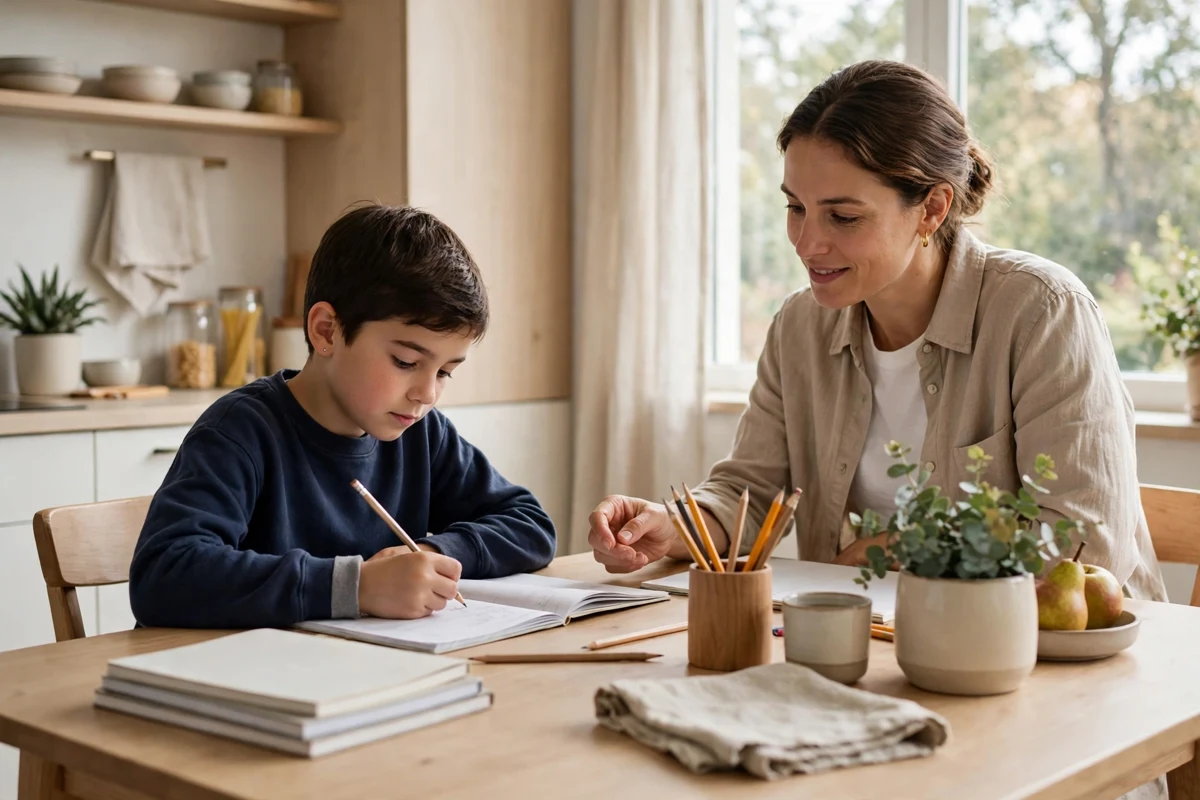
If homework time in your house involves hunting for pencils, negotiating start times and a last-minute panic before bed, the problem is rarely the homework itself. It is the absence of a system. A predictable homework routine for kids removes the daily debate by deciding in advance when homework happens, where it happens and how it gets done — so your child’s energy goes into the work, not into arguing about it.
The good news is that a routine does not need to be rigid or military. The best ones are simple, visible and built with your child’s input, and they grow more independent as your child gets older. This guide walks through building a homework routine for kids step by step, adjusting it by age, and handling the resistance that every parent meets sooner or later.
Why a Consistent Homework Routine for Kids Works
Children thrive on predictability. When homework starts at the same time each day, the question changes from “Do I have to?” to “It is homework time” — a subtle shift that ends most battles before they begin. A routine also protects everything around homework: family meals, play, reading and sleep stop being squeezed by work that expands to fill the whole evening.
There is a deeper benefit too. Following a routine teaches children to organise tasks, manage time and finish what they start — the foundations of independent study they will rely on throughout school. Routines support wellbeing as well as work, a connection explored in our guide to helping children build healthy habits for physical and mental well-being. When homework has a clear beginning and end, children can relax properly afterwards, and so can you.
Step 1: Pick the Right Time — and Protect It
Most children need a genuine break after school before they can concentrate again: a snack, some movement and a change of scene. Starting homework the moment they walk through the door usually backfires. Equally, leaving it until after dinner often means tired work and tears. For most families, a slot in the late afternoon works best, but the right time is the one your family can keep on most days, including busy ones.
Balance matters here. Children need unstructured downtime as much as they need structure, and our article on balancing structured learning with free play explains how the two support each other. Anchor homework to an existing event — after the after-school snack, before screen time — rather than to the clock alone, and agree the start time with your child so it feels chosen, not imposed.
Step 2: Set Up a Homework Spot That Works
A dedicated spot signals to your child’s brain that it is time to focus. It does not need to be a separate room: a consistent corner of the kitchen table works perfectly, provided it is reasonably quiet, well lit and free of the television. What matters is consistency — the same place every day becomes part of the routine itself.
Stock the spot with everything needed: pencils, ruler, rubber, paper and a sharpener, kept in a box or caddy so there is no excuse-generating treasure hunt. Keep phones and tablets out of the area unless a task genuinely requires one. A small visual timetable or checklist on the wall helps younger children see where they are in the routine and what comes next.
Step 3: Build the Routine Itself
A reliable sequence looks like this: sit down, open the planner or homework diary, and look at everything that is due. Let your child choose the order within reason — many teachers suggest tackling the hardest or least favourite task first, while energy is highest. Work in focused bursts with short breaks: fifteen to twenty minutes for younger children, stretching towards half an hour for older ones.
Include reading as a fixed part of the routine even when no reading is set, because daily practice compounds; our guide to improving reading comprehension through daily practice shows how little time it takes to make a real difference. End with a tidy-up and a quick review: pack the bag for tomorrow, tick off the checklist and close the homework chapter of the day properly. That closing ritual matters — it tells your child they are finished and free.
Adjusting the Routine by Age
For children aged five to seven, keep sessions short and sit nearby. Your presence is the routine at this age; read instructions aloud, praise effort and stop before frustration builds. From eight to eleven, children can manage a checklist with decreasing supervision — check in at the start and end rather than hovering throughout, and let them experience small, safe consequences of forgetting.
Teenagers need ownership more than oversight. Agree expectations together — a realistic start time, a phone parked elsewhere, breaks planned rather than drifted into — then step back. Your role shifts to keeping the environment supportive and noticing effort. This gradual handover, from sitting beside them to trusting them alone, is exactly what a good routine is for, and it mirrors the wider goal of promoting creativity, curiosity and lifelong learning in kids: independence built on structure.
What to Do When Your Child Resists Homework
Resistance usually has a cause: the work feels too hard, too boring, too long, or your child is simply tired. Start with curiosity, not consequences. Break the task into smaller pieces, agree to do the first ten minutes together, and use a timer to make the commitment feel finite. Turning a stuck moment into a problem you solve jointly teaches more than any worksheet — an approach echoed in our article on teaching problem-solving through fun activities.
If the same subject triggers tears every week, talk to the teacher; persistent struggle is information, not defiance. And if homework regularly takes far longer than the school intends, that conversation matters too. Your job is to protect both the learning and your child’s relationship with it.
The Parent’s Role: Coach, Not Cop
The routine works best when you are the calm structure around it, not the enforcer inside it. Help with instructions, ask your child to explain what they are doing, and praise specific effort — “you kept going when that sum got tricky” — rather than empty perfection. Avoid doing the work for them, and avoid correcting every error; mistakes sent back to the teacher show exactly where help is needed.
Finally, review the routine together every few weeks. What feels too early, too long, too rushed? Small adjustments, made with your child rather than to them, keep the system alive as school demands change. A homework routine for kids is not really about homework at all — it is about teaching a child that big jobs become manageable when they have a time, a place and a plan. Build it once, tend it lightly, and watch the evening battles fade.
