
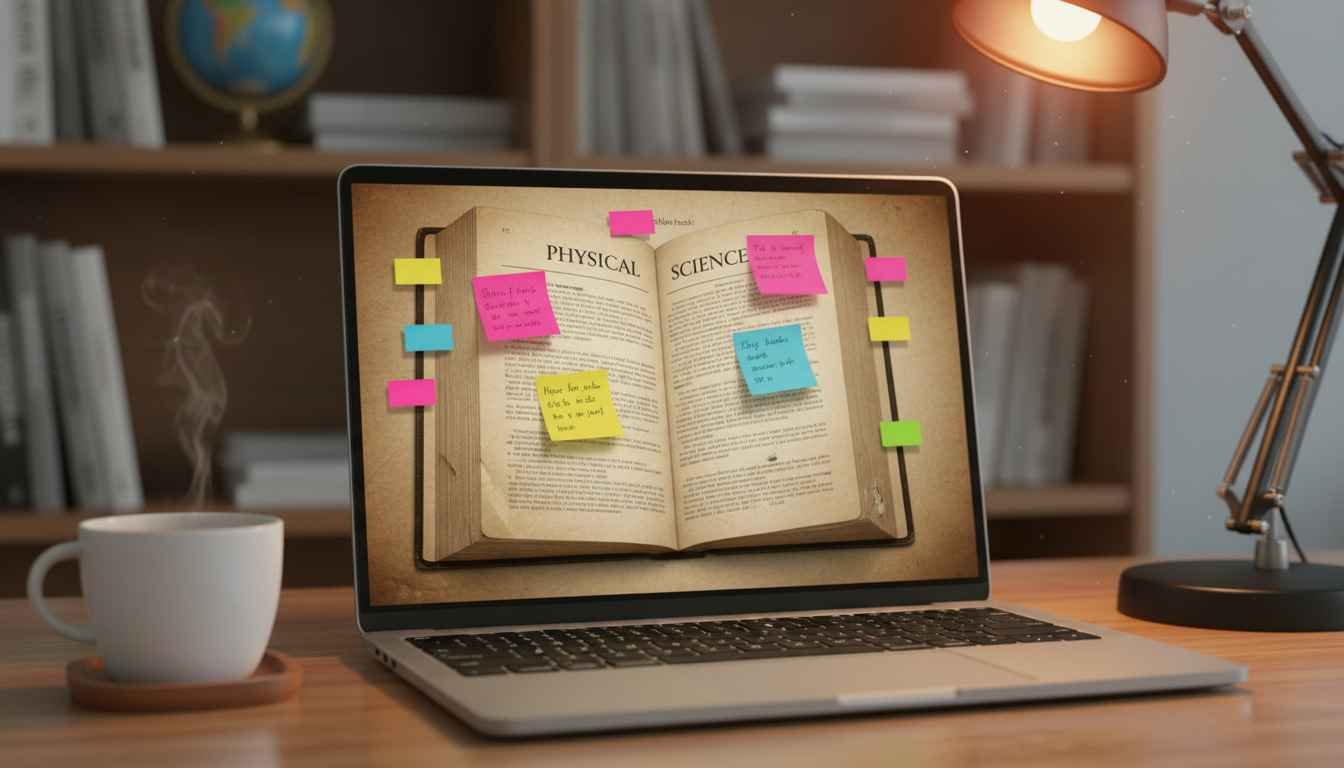
“I downloaded yet another physical science textbook PDF, and honestly, I’m not sure it helped.” That was the exact tweet I saw this morning scrolling through my feed. It caught my attention, because I’ve been there too – hours wasted on PDFs that promised clarity but delivered confusion.
Let’s be real. Physical science is supposed to make sense, right? Mass, motion, energy, forces – these are the building blocks of the world around us. Yet, when you open a random textbook PDF from some anonymous source online, the words feel more like cryptic hieroglyphs than the elegant principles scientists have spent centuries perfecting. I’ve read dozens, and the gap between expectation and reality is… staggering.
First, let’s talk accessibility. A PDF sounds convenient. Click, download, and start learning anywhere. But convenience is often an illusion. Many so-called “free” textbooks are either outdated, riddled with errors, or missing crucial diagrams. Pages that should clearly illustrate Newton’s laws often come as blurry images or broken links. For a subject that relies heavily on visual demonstrations, this is like handing someone a car manual with half the pictures missing.
Even worse is the presentation. PDFs are static. Unlike interactive e-books or platforms that allow simulations and self-check exercises, these files are rigid. You can’t click, highlight meaningfully, or test your understanding in real-time. And if you’re like me, scrolling endlessly just to find the section on thermodynamics feels like punishment.
Reality Check
Expectation: Download a physical science textbook PDF, and instantly gain clarity on complex topics. Reality: Often end up frustrated, staring at blurry diagrams, outdated terminology, or missing chapters. The promise of instant knowledge rarely matches the reality of these files.
So, why do we keep doing it? Because the internet promises instant access to everything, and the idea of carrying a 1,000-page hardcover is daunting. There’s also the allure of saving money. Many of these PDFs are free, whereas textbooks can cost hundreds. But as anyone who has suffered through a poorly formatted PDF can tell you, “free” doesn’t always equal “useful.”
Now, let me admit something. After years of chasing PDFs, I’ve learned to separate the wheat from the chaff. There are reputable sources that offer solid content without the headache. For example, academic institutions and curated libraries maintain updated PDFs with reliable references. Even for casual learners, platforms like Famous Scientists provide historical context, biographies, and insights that complement the raw science, turning a simple PDF into a gateway to understanding the minds behind the principles.
But there’s a catch, and I want to be upfront about it. Many PDFs circulate illegally, often violating copyright. Downloading these files may seem harmless, but it’s a gray area legally and ethically. More importantly, the authors and educators who spend years refining content don’t get the recognition or compensation they deserve. That means the next generation of PDFs may suffer in quality because good content isn’t being funded.
Potential Drawbacks
Confession time: even the PDFs you trust can disappoint. Sometimes, the math problems are outdated, the experiments impractical, or the context irrelevant. Some PDFs are scanned copies of decades-old editions where concepts have since evolved. In physical science, staying current matters. Outdated resources can mislead more than they educate.
Another drawback? Digital fatigue. Reading long PDFs on a screen can be mentally exhausting. It’s harder to focus, harder to annotate, and easier to procrastinate. Without physical engagement – writing notes, flipping pages, or underlining key points – retention drops significantly. The very thing that makes PDFs appealing – their portability – can undermine actual learning.
So, who should avoid this? Students who need interactive guidance, self-learners prone to distraction, and anyone looking for structured problem-solving exercises. For these groups, relying solely on a PDF is risky. You need platforms that offer quizzes, video tutorials, or even community support to truly grasp concepts. PDFs alone rarely suffice.
Money-Back Perspective
Here’s my cautious advice. Treat free PDFs as a starting point, not a final solution. Use them to skim through topics, understand terminology, or preview chapters before committing to a physical or paid digital edition. If a PDF promises total comprehension or a shortcut to mastering physical science, approach with skepticism. Learning is incremental, and quality resources – paid or freely curated – deliver incremental, trustworthy progress.
In my experience, combining PDFs with supplemental materials – videos, interactive simulations, and historical context – provides the best results. That’s where curated repositories like Famous Scientists shine. They help link the raw formulas and theories to the people and experiments that made them real. Suddenly, Newton’s laws aren’t just equations – they’re insights from minds who reshaped our understanding of the universe.
Finally, consider the discipline factor. Physical science isn’t just about reading – it’s about applying. Conducting experiments, solving problems, and questioning results. A PDF cannot do that for you. PDFs can guide, but the effort to apply the concepts must come from you. Any other expectation is setting yourself up for frustration.
Confession concluded: I’m still skeptical of the “perfect physical science textbook PDF” floating somewhere online. But I’ve learned to manage expectations, filter sources, and pair PDFs with hands-on learning. Downloading a PDF isn’t inherently bad – it’s just rarely enough. The truth is, if you want real comprehension, PDFs should supplement, not replace, engagement with science in its full, dynamic form.
